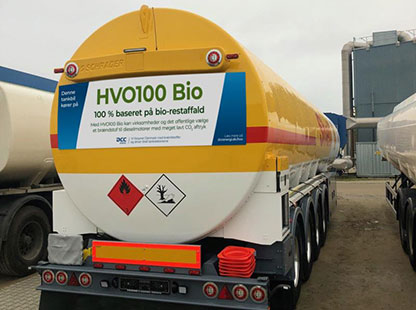
Waste oil gets a second life as biofuel and helps energy users move away from fossil fuels with ease. Orla Stevens of Certa Ireland and Steffen Kildahl of DCC Energi Denmark tell more.

“We want to make biofuel available to everybody so they can start on their carbon reduction journey,” says Orla Stevens, Managing Director at Certa Ireland. “And the fuel we’re particularly excited about is HVO.”

HVO – or hydrotreated vegetable oil – is a ‘second-generation’ biofuel. So called because, after treatment, waste oil that would otherwise go to landfill gets a second life as a lower-carbon fuel suitable for diesel engines.

“HVO is chemically comparable to diesel, so you can simply go to a fuel pump and add it to your tank without any issues or making any modifications to the engine,” says Orla.

HVO can deliver up to 90 per cent lower lifecycle greenhouse gas emissions than conventional diesel when made from waste materials such as used cooking oil. “What’s so good about it is that it gives you the opportunity to reduce carbon emissions from the second you start using it,” she adds.

HVO at a glance

4.5 billion tonnes of fossil oil is consumed every year
60%
Scope 1 emissions John Sisk & Son saved using HVO
40%  of oil consumption will be biofuels by 2040
70%
Denmark's carbon reduction target by 2030*
90% reduced carbon emissions delivered by HVO
COLD READY
HVO offers strong performance in colder conditions
HVO plays a key role in reducing emissions

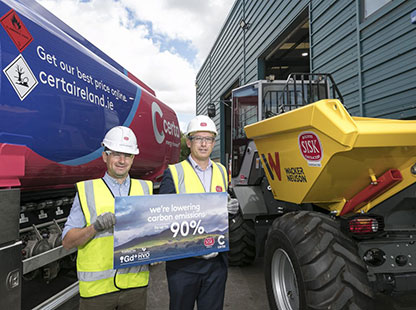
Certa Ireland – part of DCC Energy – switched its delivery fleet to HVO in March 2023 after a trial the previous year and has helped customers including construction company John Sisk & Son and Dublin Port with their own transition away from fossil fuels.

DCC Energy businesses in the UK, Austria, Sweden and Denmark are also working with customers to reduce their emissions by switching to this lower-carbon fuel.

In 2024, DCC Energi secured a four-year public sector contract in Denmark, becoming the exclusive supplier of HVO across the state, regional authorities and all 98 municipalities.

“We’re proud of this. It recognises the strength of our HVO offering and the value we deliver to customers, while reinforcing that we’re on the right path,” says Steffen Kildahl, Sales Director at DCC Energi.

Denmark has set some of the most ambitious climate targets in Europe. “Having already committed to reducing emissions by 70% by 2030 compared with 1990 levels, the country has since increased its ambition and now aims to achieve an 82% reduction by 2035,” says Steffen. HVO has a key role to play in this ambition. DCC Energi supplies HVO to a growing number of businesses across Denmark and has expanded availability through a nationwide network of service stations.

For customers looking to reduce emissions today, HVO offers an immediate and practical solution. “It’s what I call a plug-and-play fuel,” says Steffen. “There are no technical issues to overcome, unlike other solutions still in development. It’s available. And we have it in stock. I love how it can make such a difference.”

DCC ENERGY IN ACTION

FIVE BIOFUEL MYTHS DEBUNKED

Biofuels help energy consumers reduce their carbon footprint. Yet myths about them persist. So, what’s true and what’s false?

Why more businesses are switching to HVO

Steffan sees the new public sector contracts having a ripple effect. “As municipalities specify HVO for their own tenders for things like public transport contracts, more businesses will start using it – because they have to,” he explains.

So, what’s the process for a commercial fleet manager to make the change from fossil diesel to HVO? Assuming they don’t simply say: “Fill her up!”

Orla laughs: “Most of our customers have started small. And we do say that it’s worth checking in with your original equipment manufacturer first.” Having said that, the changeover is straightforward. Referring to Certa’s own HVO transition, she notes: “Whether a vehicle was built in 2003 or 2023, we’ve found what make or model you drive makes no difference to performance.”

She points out the success of customer HVO trials at Certa. The carbon dioxide equivalent (CO2e) savings can be big. John Sisk & Son for example produced 3,000 tonnes a year of CO2 from diesel, around 60 per cent of its Scope 1 emissions. The company now uses HVO in everything from generators to supersized diggers at its sites across Ireland – a logistical delivery challenge that Certa was happy to rise to.

Because HVO emits less particulate matter than conventional fossil diesel, the effect of reduced emissions is more tangible. You no longer see the same dirty exhaust fumes from Dublin Port’s pilot boats as they escort ships safely into port, a benefit appreciated by Dublin Port as it works towards its climate targets.

HVO for farming, transport and home heating

DCC Energy is already working with businesses with ambitious net zero targets, as well as organisations for which sustainability is paramount.

In 2023, the British Antarctic Survey (BAS) trialled HVO on the polar research ship RRS Sir David Attenborough. Certas UK, part of DCC Energy, supplied 1.5 million litres of HVO for the vessel’s Antarctica voyage after demonstrating the fuel’s ability to perform in temperatures below minus 26°C.

High-emissions industries such as farming and road haulage are obvious markets for HVO. Certa has significantly expanded access to HVO across Ireland, with the renewable fuel now available at 25 locations nationwide. Orla also sees potential in the off-gas-grid domestic market, as HVO can be dropped into oil-fired heating systems.

CSO's 2024 Household Environmental Behaviours survey – published November 2025 – found that 26% of people in Ireland report kerosene as their main heating fuel, rising to 41% in rural areas specifically. "Not every household is in a position to install a heat pump today. Recent ESRI research suggests that lower-carbon fuels such as HVO can help reduce emissions now without discouraging future adoption of heat pumps. That means households can take meaningful action today while keeping their long-term options open," she says.

“We have strong supplier relationships and are used to negotiating contracts for legacy fuels that we can now apply to HVO. As part of DCC Energy, we also benefit from the scale, market insight and purchasing power of a broader international energy business, helping us secure strong long-term supply arrangements. It’s bread and butter for us,” Orla shares. “We have the logistics, and we’re already set up for this with hundreds of trucks, depots and storage tanks. Outbound logistics is something that we do quickly and cost-effectively. The opportunities are endless.”

*Against a 1990 baseline